Cota Cero: a sample website for a remodeling company
Cota Cero is a sample remodeling company: it doesn’t exist and it isn’t a client. We built it to solve, on a website that actually works, what keeps someone who needs a remodel from picking up the phone.
We found four problems. None of them gets fixed with a nice line on the home page.
Nobody calls without a rough idea of the price
A remodel is one of the biggest things a family ever pays for, and almost every contractor website handles it with a “request a free estimate” button. Someone who’s just starting to look doesn’t want to let a stranger into their home only to find out they can’t afford it. So they don’t call, or they call five companies at once.
What we did
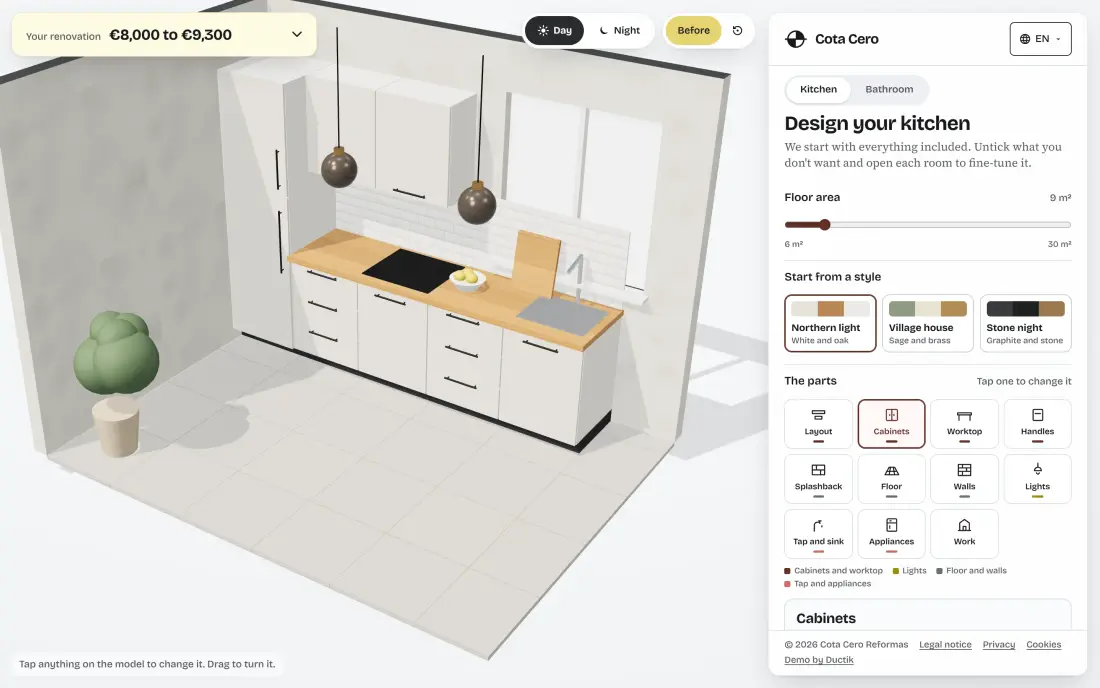
Right on the home page, a model of the apartment builds itself as they scroll, and one click takes them inside. There they tap a room, choose the size, the flooring, the walls or the kitchen cabinets, zoom in for a closer look or keep just the kitchen. With every click two things change: the 3D model and the price. When they’re done, they get the design as a PDF in their inbox or send it over WhatsApp, already written out.
What you don’t see
The model is built right in the browser for any mix of size, bedrooms and bathrooms, and it redraws instantly without losing what’s already been chosen. The price adds up room by room using the company’s own rates, with no form to fill out.
What really scares people is the job itself
That it drags on, that the cost goes up halfway through, that the house is a mess for weeks, that nobody answers if something breaks. Everyone has heard those stories, and they make even people who already have an estimate hesitate. Most websites brush it off with “quality and trust,” and that doesn’t reassure anyone.
What we did
On the home page, visitors step into a room in ruins. As they scroll, the job unfolds step by step, with dates: the walkthrough on day one, the floor plan with a fixed price within five days, demolition in week one, and so on until the finished job is handed over in week eight. Behind the steps, the room gets remodeled as they scroll. Several steps carry a specific promise: debris hauled out every afternoon, a progress report every Friday, no change without a price.
What you don’t see
Every step has a date because the real question is how long the house will be torn up, and the promises are the kind customers can check for themselves. By the end, all seven stay on screen, like a calendar. The text sits on a pane of glass with the room changing behind it, and it has to read just as well over crumbling walls as over the finished remodel.
Every remodeling website looks the same
Stock photos and a contact form. Someone comparing five companies doesn’t remember any of them, and ends up choosing on price.
What we did
Cota Cero opens with its name, still, and the camera moves inside the O until it reaches the room. It’s an entrance people remember, and it already says what the company does: come into your home and change it.
What you don’t see
An entrance like that can’t make anyone in a hurry wait. It lasts a few seconds, any tap speeds it up, and if a visitor has asked their phone or computer for less motion, the site respects that and stays still.
And all of it on a phone
Almost everyone looks for a remodeler on their phone, often with a weak signal. Anything the site downloads and doesn’t use is time spent waiting, and on a small screen it’s easy to lose sight of the price or the button to get in touch.
What we did
Each piece arrives when it’s needed: the 3D model on the home page only downloads when the visitor gets close to it, and the rest of the panel when they open it. If the phone can’t handle 3D or asks for less motion, they see a still image of the apartment. On a phone, the photos of the room come cropped to fit the screen, and in the panel the price and the WhatsApp button stay pinned to the bottom while they choose; the email option opens from that same bar.

What you don’t see
The same design has to work on a computer screen and on a phone: the seven steps go from one row to one column, and the 3D model, which shares the screen with the options on a computer, moves to the top on a phone and makes room for the price bar.
Try it
The website is live and fully working, from the panel and its PDF to the WhatsApp message. The prices are samples. It opens in Spanish; you can switch it to English in the language menu at the top, and the PDF and the WhatsApp message come out in English too.